Voters in six states on Nov. 3 will decide whether to approve ballot measures that would amend their state constitutions or state law to make U.S. citizenship a requirement for voting.
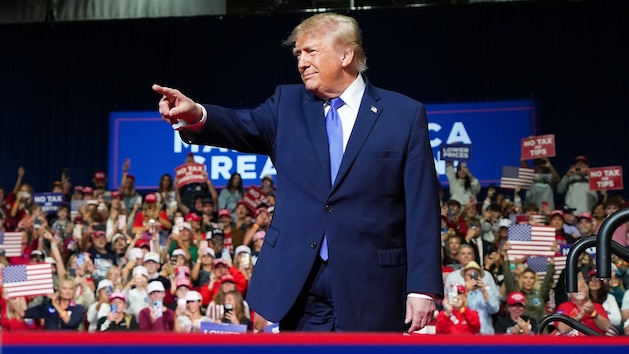
The closely watched popular referenda reflect a push by President Donald Trump to crackdown on noncitizen voting based on unsubstantiated claims of widespread voter fraud.
Voting-rights advocates warn they also raise the potential of sidelining millions of eligible American voters.
“Rather than strengthening democracy, [the amendments are] a political maneuver designed to justify future rollbacks of voting rights,” said Rashane Hamby with the ACLU of Kansas in testimony last year.
Federal and state laws already prohibit noncitizens from voting in any federal or statewide election, but advocates for the constitutional amendments say even more protection is needed.
“Law can change, as we know,” said West Virginia state Sen. Patricia Rucker, a Republican, at a press conference last month. “This proposed amendment would ensure that no future legislature could just simply change the election law with only a bill.”
No state constitution currently includes a citizenship requirement for voting. Five states — Arizona, Arkansas, Kansas, South Dakota and West Virginia — have amendments on the ballot. An Alaska initiative would create a new state law.
Of particular concern to some supporters: major cities in three states plus the District of Columbia that do allow some noncitizens to lawfully participate in local elections.
“There’s nothing that magically stops those bad ideas at that state’s borders,” said Arkansas state Rep. David Ray in a news conference last month.
Many civil rights groups and nonpartisan voter advocates fear the measures — and accompanying regulations requiring proof of citizenship to register to vote — could disenfranchise tens of millions of Americans.
Jemmie Lolita Pepper of Indiana, a former public-school educator who was born on U.S. soil but spent decades unable to prove it, says she empathizes with both sides of the debate.
“I understand the desire to require proof so there won’t be voter fraud or anything like that. I truly support that: no voter fraud,” said Pepper, 63, in an interview. “But for those of us who had to live years of not having [any documentation], you couldn’t prove it. I couldn’t.”
With pro bono legal help, Pepper recently untangled a series of clerical errors in state records — including a misspelling of her first name and faulty substitution of her last name — that had prevented her from obtaining an official government ID and, in turn, casting a ballot. She now has one.
“They had my name listed as the boys’ spelling, J-I-M-M-I-E,” Pepper recalled of her legal odyssey. “I said, ‘Well that’s still me. That’s still me.'”
An estimated 21.3 million Americans — or 9% of all eligible voters — are unable to readily present documentation proving they are citizens because of misplaced or inaccessible records, financial hardship putting replacement fees out of reach, name changes from divorce or remarriage, and clerical errors in state databases, according to a 2025 study by the University of Maryland.
Only 48% of Americans have a valid passport as of 2023, according to the State Department.
Some voting-rights advocates say a proof-of-citizenship requirement would hit elderly, disabled and rural voters particularly hard.
“I’ve been through SCUD missiles, riots, sniper fire. To be unable to keep it together navigating all these processes makes me ashamed to say, but it would be really difficult,” said Symmone Ford of Michigan, a 56-year-old Gulf War veteran with severe PTSD who has difficulty leaving her home.
“I can’t afford the money for a lawyer to change my name. I barely have enough to pay my bills,” said Ford, whose last name does not currently match her birth certificate because of several marriages and divorces.
Additional paperwork requirements for voter registration could effectively shut down online access, some experts said. Even when people do have proper documentation, many may lack access to copiers, notaries and scanners to submit electronically.
Nine states currently have laws requiring state officials to verify a voter’s citizenship status either by looking at documentary proof at time of registration, reviewing voter registration history, or cross-checking with other government databases, according to the National Conference of State Legislatures.
Federal law requires voters in all states to attest with a signature — under threat of imprisonment — that they are, in fact, U.S. citizens when they sign up for a ballot.
Still, 83% of Americans, according to Gallup, say people registering to vote for the first time should have to provide documentation to show that they are eligible citizens.
Efforts by Trump and his Republican allies to institute a nationwide proof-of-citizenship standard stalled in Congress earlier this year and later got blocked by federal courts when he attempted to impose it by executive order.
An online tracker of major public claims of noncitizen voting compiled by the nonpartisan Center for Election Innovation and Research shows cases of noncitizen voting are extremely rare.
In Michigan, for example, the state attorney general identified 38 credible cases of noncitizen voting in the 2024 general election out of roughly 5.7 million votes cast. That’s 0.0000066% of total votes cast.
Six of the Michigan cases have resulted in criminal charges, while 10 were closed without charges and 22 are still under review, according to state officials.
Eighteen states did not publicly disclose finding or removing any noncitizen from a voter registration list in the 2024 election, and no state uncovered any coordinated effort to get noncitizens to vote, according to CEIR records.
President Trump and the Department of Justice continue to push unsubstantiated claims of widespread noncitizen voting as the basis for tighter voter registration rules and ballot segregation in several states, including California and Washington.
The U.S. Supreme Court has previously struck down efforts to add a proof-of-citizenship requirement to federal voter registration forms. Later this year, in a major case from Arizona, the justices will decide whether states can mandate proof-of-citizenship on state forms and for voting in state races.
Copyright © 2026, ABC Audio. All rights reserved.
